
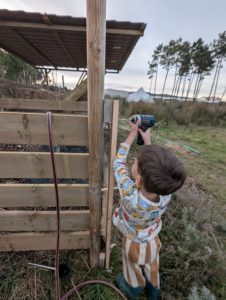
A child learning to observe, care, create, cooperate, and belong in the living world.
There is a moment I love watching in the garden, when a child suddenly stops because something has caught their attention.
It can be an ant trail crossing a path, a curled leaf, the smell of mint after being touched, a worm moving through the soil, or water disappearing into dry ground. Sometimes the child calls someone over immediately. Sometimes they crouch quietly for a long time, absorbed in a world that the rest of us might have walked past.
That pause feels important to me.
It is a small moment, easy to miss, but so much begins there: attention, curiosity, relationship, wonder, care. This is where I think a Garden Explorer begins — in that willingness to notice.
At Alo Lira: Garden Explorers, I think of the garden as a prepared environment. Maria Montessori used this expression to describe a space arranged with care, so that children can move, choose, repeat, concentrate, and gradually become more independent. Usually, we imagine this inside a classroom, with beautiful materials, child-sized furniture, order, calm, and purpose.
A garden brings another kind of preparation. It has weather, mud, insects, wind, surprise, growth, decay, and plans that need to change because the rain came, or because the soil was too dry, or because a child found a beetle and suddenly everything else had to wait.
Still, the garden can be prepared with intention. There can be child-sized tools, clear boundaries, beautiful materials, meaningful work, quiet corners, places to move, places to gather, and adults who are paying attention without taking over too quickly.

There are plants to water, compost buckets to empty, dough to knead, seeds to sort, branches to carry, songs to sing, paths to sweep, food to prepare, animals and insects to observe, and tools to care for. There are also moments when nothing needs to be done except look closely.
This balance matters to me: the doing and the noticing.
Permaculture begins with observation. Before planting, building, harvesting, or changing anything, we look. We notice where the sun falls, where water collects, which plants are thriving, which insects appear, what has changed since last time. We look for patterns and relationships before deciding what to do.
Children understand this beautifully when they are given time.
They see that soil feeds plants, plants feed insects, insects help fruit grow, food scraps become compost, and compost returns to the soil. They begin to understand that the garden is a web of relationships, not a collection of separate things. Watering a plant, returning scraps to compost, or being careful around a tiny seedling becomes part of a larger story.
We care for the garden, and the garden cares for us.
Montessori wrote and spoke often about the importance of purposeful activity, movement, independence, and the work of the hands. I return to this often because it is so visible with children. The hand really is connected to the mind. When a child pours, carries, folds, digs, plants, threads, cuts, mixes, builds, or washes, there is so much happening: coordination, concentration, judgement, patience, strength, sequencing, and confidence.
In the garden, these skills are practised with a real purpose. The plant is thirsty. The dough will become bread. The compost will feed the soil. The shelter needs another branch. The younger child may need help. The song may bring the group together again.
There is a dignity in being allowed to participate in real life.
A child carrying water carefully to a plant is measuring their strength, coordinating their body, noticing the needs of something living, and discovering that their effort has an effect. That discovery can be deeply nourishing. Confidence grows through experiences like this, repeated many times, in many forms.
Albert Bandura’s work on self-efficacy points to something similar: one of the strongest foundations for confidence is the lived experience of trying, practising, and becoming capable. Children need to feel capability in their own bodies, not only hear adults tell them they are capable.
Research on motivation, especially Self-Determination Theory from Edward Deci and Richard Ryan, also gives useful language for something many parents and educators observe intuitively. Children thrive when they experience autonomy, competence, and relatedness. They need some freedom to choose, opportunities to feel capable, and a sense that they belong with others.
The garden can offer all three in very concrete ways. A child may choose how to enter the activity, take part in work with visible results, and feel that their presence matters to the group. They may discover, without anyone needing to make a speech about it: I can help here. I know where this belongs. I can try again. I am part of this.
This is self-esteem in a grounded form. It grows from real encounters with the world.
Of course, children do not all enter in the same way. Some arrive through movement, wanting to dig, carry, run, climb, and build. Others are drawn to making: folding, weaving, mixing, shaping, arranging, collecting. Some come alive through music and rhythm. Some are happiest caring for animals or plants. Others need to watch for a while from the edge before they feel ready to join.
I think this watching is often underestimated.
A child who watches quietly may be learning the rhythm of the group, understanding who is who, noticing what feels safe, and deciding how they want to participate. There is intelligence in that. There is self-knowledge. There is also trust, when the adults allow the child to take the time they need.
Peter Gray’s work on play and self-directed learning is helpful here. He writes about the importance of children having real opportunities to explore, choose, negotiate, take initiative, and learn from one another. Social learning grows richly when children are together around something meaningful, with enough freedom to participate in their own way and enough safety to know they are held.
The garden offers many natural invitations into social life. Someone holds a branch while another ties it. Two children carry a basket that would be too heavy for one. A discovery gathers a small crowd. The watering can requires waiting. A small plant asks everyone to place their feet carefully. A shared snack becomes a moment of belonging.
This is how cooperation, empathy, patience, and communication are practised in real time.
A child watching someone gently hold a worm may be learning tenderness. Waiting for the watering can can become a small practice in patience. Carrying a heavy basket with another person gives the body an experience of cooperation. Noticing a broken stem may become a moment of care. Returning scraps to the compost teaches, very quietly, that nothing in nature is truly “away.”
These are small moments, and they are also the substance of childhood.
There is something else too, harder to measure but easy to feel. Children need to experience themselves as part of something larger than their own immediate wishes. A garden makes this possible without being abstract. There are seasons, rhythms, needs, gifts, limits, surprises. There is life before us and life after us. There are things we can influence and things we need to respect.
Research on nature connection has linked children’s relationship with the natural world to wellbeing, attention, and later care for the environment. This makes sense to me. It is hard to care deeply for something we have never touched, watched, smelled, waited for, or helped to grow.
When children spend time in a garden, they are participating in a living place. They begin to see that their actions matter: water can revive, rough hands can damage, patience can reveal, leftovers can become soil, and care can return in unexpected ways.
A Garden Explorer explores the garden, and also begins to discover themselves there.
One child may find that they love small creatures. Another may discover the satisfaction of building something large and sturdy. One may realise that music helps them feel brave. Another may learn that they prefer to watch before joining. Someone may find out that waiting is hard. Someone else may discover the pleasure of helping a younger child. These discoveries are part of development too.
The garden does not divide the child into separate categories: academic, social, emotional, physical, creative. The whole child arrives. There is movement, language, rhythm, practical life, sensory experience, problem-solving, responsibility, friendship, imagination, and rest. There is beauty too, and I do not think beauty is a small thing in childhood.
At Alo Lira: Garden Explorers, the work is inspired by Montessori, permaculture, self-directed play, music, mindfulness, and the belief that children are capable of much more than they are often given the chance to show.
We prepare the environment, offer invitations, and pay attention to how each child finds their way in.
Over time, a Garden Explorer learns to observe, make, care, cooperate, and see connections. Perhaps, underneath all of that, something even more important begins to take root: a quiet sense of capability and belonging.
The feeling that:
I can do things that matter.
I am part of this place.
I belong with others.
My actions make a difference.
And that is a beautiful beginning.
 English
  Portuguese